







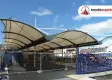
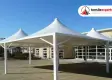
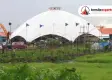
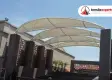





















A petrol pump canopy shares the same underlying structural approach as our general tensile canopy product, but the real design requirements are specific to a fuel-dispensing site — fire-safety clearance, tanker-truck height clearance, and fuel-brand signage integration. This guide goes through what a proper tensile petrol pump structure needs, and how it compares to a general canopy or entrance structure.
In This Guide
- What a Petrol Pump Structure Needs to Solve
- Fire-Safety Clearance from Fuel Dispensers
- Tanker-Truck Height Clearance
- Branding & Signage Integration
- Drainage Around the Dispensing Area
- Choosing a Fabric Grade
- What Actually Drives the Cost
- Petrol Pump Structure vs. General Canopy vs. Entrance Structure
- Our Process, Step by Step
- Maintenance
- Related Guides
- Available in Your City
- Explore by Product
- Frequently Asked Questions
What a Petrol Pump Structure Needs to Solve
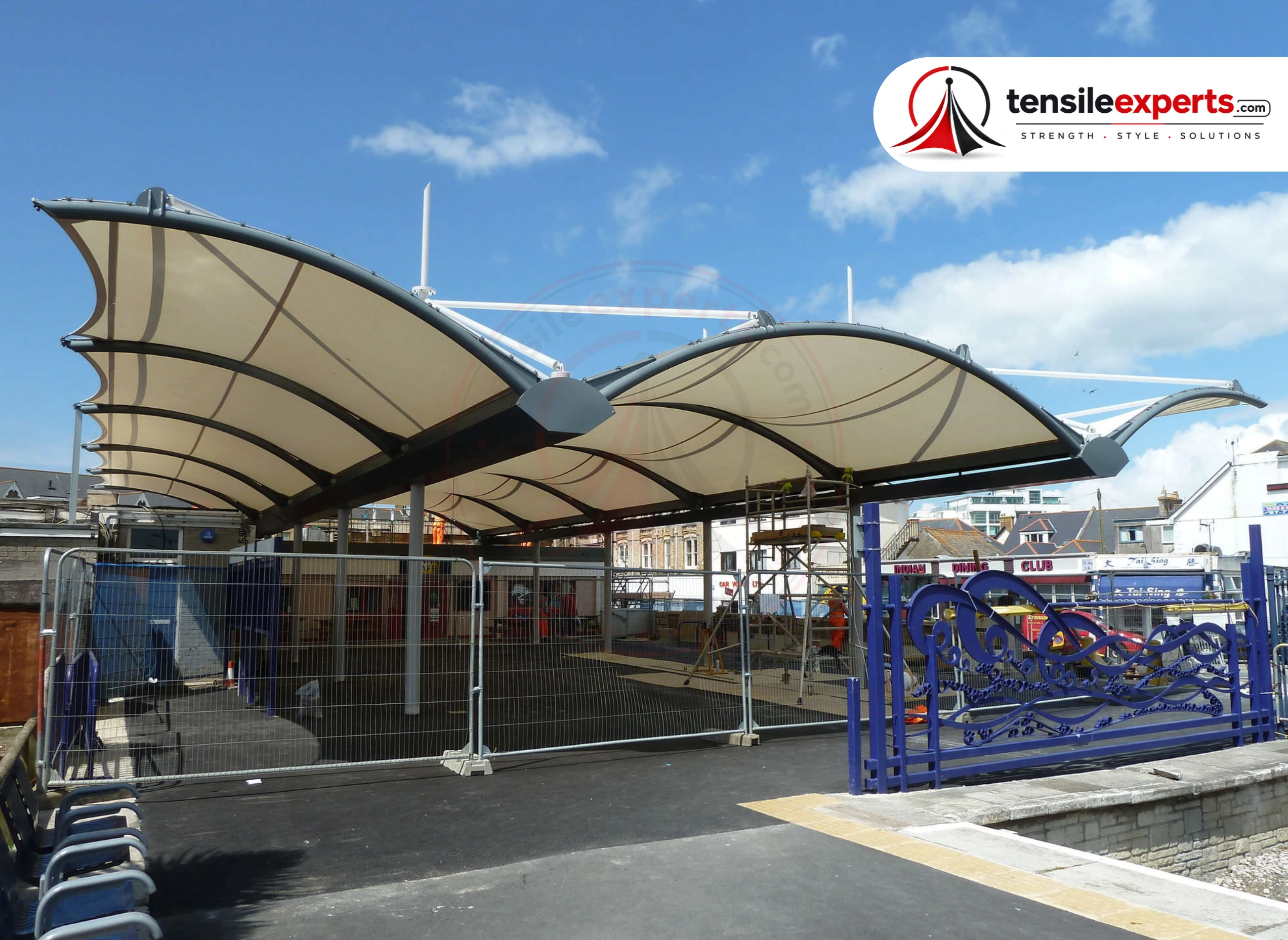
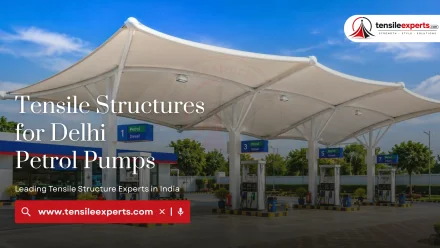
A petrol pump canopy covers the fuel-dispensing area and the vehicles being refueled underneath it — structurally close to our general tensile canopy structure, but with real site-specific requirements layered on top: fire-safety clearance from the dispensers themselves, height clearance for tanker deliveries, and fuel-brand signage that's often central to the design brief.
Fire-Safety Clearance from Fuel Dispensers
Fire-safety clearance from fuel dispensers is a real design constraint specific to petrol pump canopies — we work within the safety clearances your site's fuel-dispensing layout requires, coordinated with your existing compliance requirements rather than imposing a generic canopy design on a fuel-safety-sensitive site.
Tanker-Truck Height Clearance
Clearance needs to accommodate fuel tanker trucks during refilling, not just regular customer vehicles — a taller requirement than a typical car-focused canopy. Tell us your site's tanker access pattern and delivery frequency during the site visit so clearance height is sized correctly from the start.
Branding & Signage Integration
Branding and signage integration is a standard part of petrol pump canopy projects — these structures are typically a highly visible extension of the fuel brand's identity, seen by every vehicle passing the site. Tell us your branding requirements during the design phase so color, signage mounting, and lighting are planned in together, not added on afterward.
Drainage Around the Dispensing Area
Drainage is engineered to direct water away from the fuel-dispensing area specifically — a real site-safety consideration, not just a general roof-drainage question. This factors into the structural form and slope during design, checked against your site's actual dispenser layout.
Choosing a Fabric Grade
PTFE is worth considering for a high-traffic commercial fuel station given continuous exposure and constant vehicle/tanker activity; PVC can suit smaller, lower-traffic installations. See our tensile structure page for the full fabric-grade breakdown.
What Actually Drives the Cost
Forecourt size and pump count are the primary cost drivers — a larger multi-pump station costs proportionally more than a small single-pump site. Fabric grade and branding/signage complexity are the next factors.
Tensile Canopy Structure — From ₹320/sq.ft.
Petrol Pump Structure vs. General Canopy vs. Entrance Structure
All three share a similar structural form, but the design priorities differ:
| Aspect | Petrol Pump Structure | General Canopy | Entrance Structure |
|---|---|---|---|
| Key Requirement | Fire-safety clearance, tanker height | General weather coverage | Facade prominence, design review |
| Signage/Branding | Central to the design brief | Secondary consideration | Building-identity focused |
| Typical Setting | Fuel stations, forecourts | Walkways, secondary entrances | Building main entrances |
| Clearance Driver | Tallest tanker/delivery vehicle | Pedestrian/general vehicle | Drop-off vehicle height |
See our entrance structure page if your project is a building facade statement rather than a fuel-dispensing forecourt.
Our Process, Step by Step
| Step | What Happens |
|---|---|
| 1. Initial Discussion | A call or site visit to understand your forecourt layout and pump count. |
| 2. Site Assessment | Fire-safety clearance check, tanker-access measurement, drainage review. |
| 3. Design & Branding Integration | Canopy form, fabric grade, and signage/branding mounting proposed together. |
| 4. Quote & Sign-Off | A site-specific quote confirmed before fabrication begins. |
| 5. In-House Fabrication | Cutting, welding, and frame preparation carried out by our own team. |
| 6. Installation | On-site erection coordinated around live forecourt operations. |
| 7. Handover & After-Sales | Final inspection with you, followed by ongoing maintenance support. |
Maintenance
Periodic cleaning, re-tensioning, and hardware inspection are recommended, same as any tensile fabric structure — a forecourt in continuous fuel-vapor and traffic exposure is worth inspecting somewhat more often than a lightly-used canopy elsewhere. See our full maintenance guide for the general checklist.
Related Guides


Available in Your City
We design, fabricate, and install tensile petrol pump structures pan-India. Here's the underlying canopy product page for several major cities to start with:
Not seeing your city? We install pan-India — get in touch to confirm coverage.
Explore by Product



See the full product directory for everything we design and fabricate.
Frequently Asked Questions
Planning a tensile petrol pump structure? Get in touch for a free site consultation.